
Laminate vs. Luxury Vinyl Plank (LVP):
Which Is Better for Austin Homes?
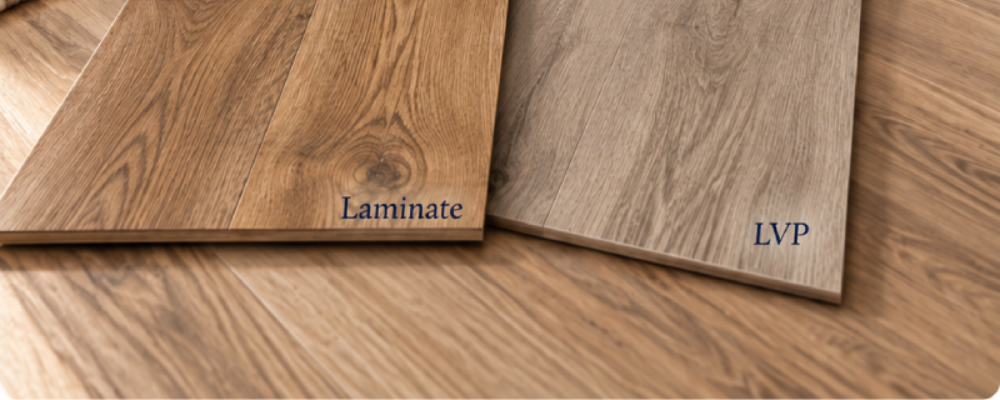
Quick Answer: Luxury vinyl plank is still a great choice for many Austin homes, especially where water exposure is a major concern. But laminate has changed significantly in the last several years. Today’s better laminates offer realistic wood looks, excellent scratch resistance and much better water protection than older products. In many homes, especially those with kids, pets and heavy everyday traffic, we may actually prefer a premium laminate over LVP.
If you haven’t looked at laminate flooring in 10 or 15 years, you may be surprised by what you see today.
For much of the last decade, luxury vinyl plank—usually called LVP—became the go-to answer for homeowners who wanted a durable alternative to hardwood. Laminate never went away, but it definitely took a back seat.
Now we’re seeing that change.
The better laminate products coming into our showroom look and perform very differently from the laminate many homeowners remember. The wood visuals are more realistic, the surfaces are tougher, and water protection has improved substantially.
Products such as Mohawk RevWood and Mannington’s Restoration Collection are good examples of how much the category has advanced.
At Landers Premier Flooring, we’re taking laminate very seriously again. In fact, depending on the home, it may be the product we recommend first.
What’s the Real Difference Between Laminate and LVP?
They can look very similar once installed, but laminate and LVP are built differently.
Laminate has a wood-based core with a decorative image layer and a hard protective surface on top. With today’s better products, the printing and texturing can be extremely detailed. Grain patterns, knots, color variation and even the edges of the plank can be designed to look more like real hardwood. Within LVP, core construction matters too. Our SPC vs. WPC guide explains the differences.
LVP is made primarily from synthetic materials. Most of what we sell today is rigid-core vinyl, which gives the plank stability while maintaining the water-resistant qualities people associate with vinyl.
Both can be attractive. The better choice usually comes down to how the floor will be used.
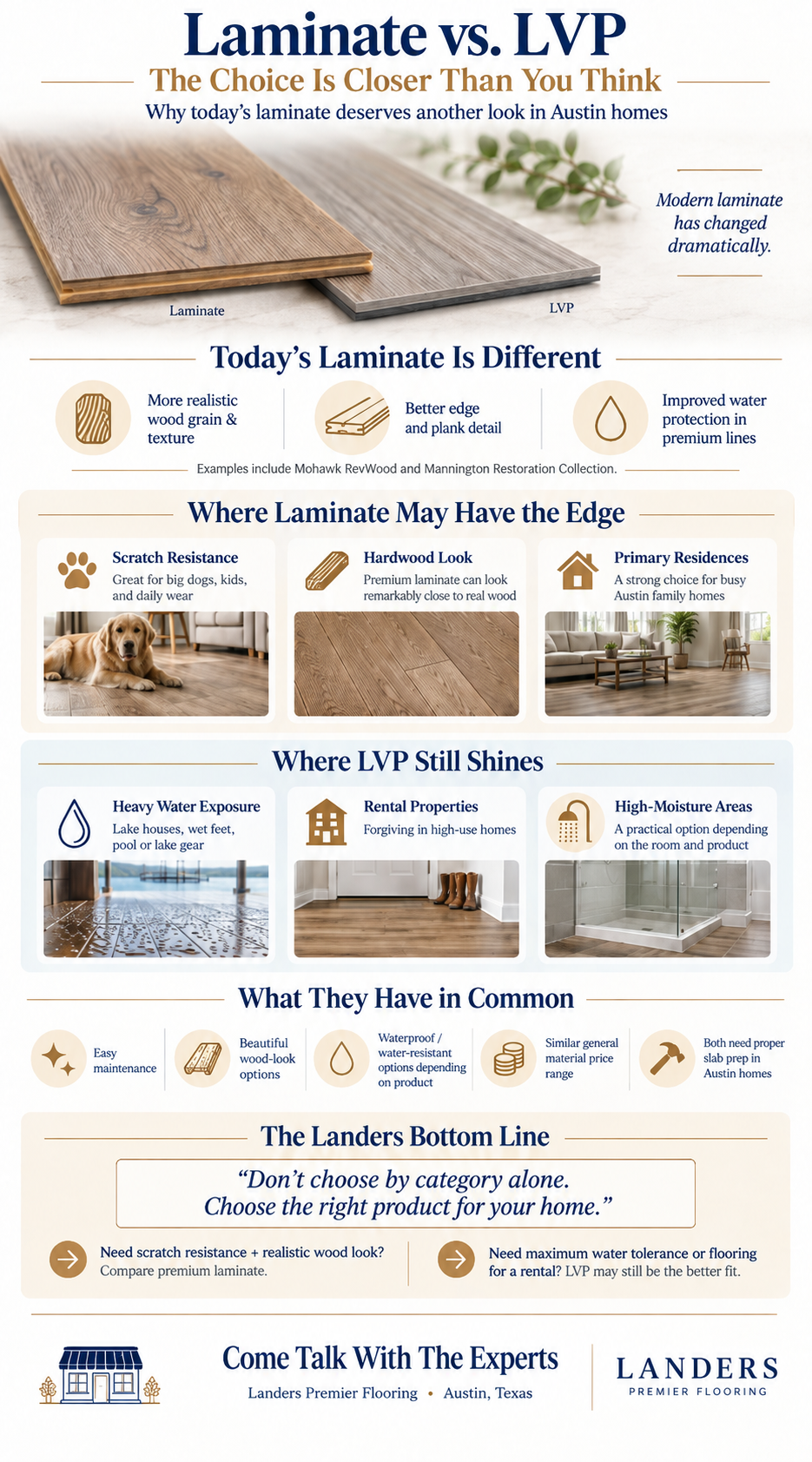
Laminate Has Come a Long Way
One of the biggest misconceptions about laminate is that it’s a dated, inexpensive product meant mainly for entry-level installations.
That’s simply not what we’re seeing anymore.
Premium laminate has improved considerably in both appearance and performance. Some of the better products have deep, realistic textures that line up with the printed wood grain. Plank edges have improved. Pattern repetition is less obvious. The overall result is a floor that can look surprisingly close to hardwood.
That matters in Austin homes with large, open floor plans.
When the same flooring runs through the kitchen, family room, dining area and hallways, you see a lot of it at once. Repeated patterns or artificial-looking grain can become much more noticeable.
With the better laminates available today, that is much less of an issue.
One of Laminate’s Biggest Advantages: Scratch Resistance
This is probably the biggest reason we’re looking harder at laminate again.
That can make a real difference in a busy household.
Large dogs, dining chairs, kids, shoes, grit and normal everyday activity can all take a toll on a floor. LVP is durable, but that doesn’t mean it can’t scratch or scuff.
A good laminate has a very hard protective surface, and that surface tends to handle scratching exceptionally well.
So if we’re helping a family with two big dogs choose between laminate and LVP, we’re not automatically steering them toward vinyl anymore. We may actually prefer the laminate.
What About Water?
This is where the conversation used to be much easier.
Years ago, if water was a concern, LVP usually won.
Traditional laminate had a wood-based core that could swell if enough moisture reached it. Vinyl, by comparison, was viewed as the safer choice.
Today’s premium laminate has narrowed that gap considerably.
Products such as Mohawk RevWood Plus and Premier offer waterproof systems designed to protect against spills, pet accidents and everyday household moisture. Mannington offers similar technology in its Restoration Collection.
That has made us much more comfortable using laminate in areas where we might not have considered it years ago.
There is an important qualifier, though:
Not every laminate is waterproof.
This is one of those areas where the specific product matters. A homeowner shouldn’t assume that all laminate performs the same way just because one premium product carries a waterproof warranty.
The installation also has to follow the manufacturer’s requirements.
Where Would We Still Lean Toward LVP?
There are still homes where LVP makes a lot of sense.
A lake house or a home with a pool is one example.
If people are regularly walking in with wet feet, bathing suits, towels and lake gear or pool gear, LVP offers a level of practicality that can be hard to argue with.
We’ve covered this in more detail in our guide to Flooring for Austin homes with pools.
We also often consider it for rental properties. Owners don’t always have control over how tenants handle spills, leaks or routine maintenance, so having a very forgiving floor can be valuable.
Even then, we don’t automatically eliminate laminate from the conversation anymore.
The better waterproof laminates have improved enough that we think they deserve to be compared side by side with LVP.
Which Looks More Like Real Hardwood?
This is an area where laminate has become especially interesting.
LVP can look very good. There are beautiful vinyl floors on the market today.
But some of the better laminates do an exceptional job of recreating wood.
The hard surface allows manufacturers to create very detailed textures, and the better products can reproduce grain, knots and natural variation extremely well. Some also use edge treatments that make the individual planks look more like actual wood boards.
For a homeowner who loves the look of hardwood but wants something more forgiving for pets and everyday life, premium laminate is absolutely worth seeing in person.
We think this is especially relevant in Austin neighborhoods where homeowners want a higher-end wood look throughout larger living spaces but may not want the maintenance or cost of hardwood.
Does LVP Feel Softer or Sound Quieter?
Sometimes, but we wouldn’t choose a floor based on that assumption alone.
A lot depends on the actual product.
Plank thickness, attached pad, underlayment, slab preparation and the flatness of the floor can all affect how a floating floor feels and sounds.
We’ve seen laminate installations that feel very solid underfoot, and we’ve seen vinyl installations that don’t.
This is another reason we encourage customers to compare actual products instead of making a decision based on the category name.
Austin Concrete Slabs Matter With Both
Most Austin-area homes are built on concrete slabs, and that matters whether you choose laminate or LVP.
A floating floor does not hide problems in the slab.
The concrete still needs to meet the manufacturer’s requirements for moisture and flatness. High spots, low spots and other irregularities may need to be addressed before the flooring goes down. Whichever product you choose, preparation still matters. See our floor-prep guide for what should happen before installation begins.
This is one of the areas where installation quality matters just as much as product selection.
If the slab isn’t properly evaluated and prepared, either type of flooring can have problems. Movement, noise and damage to the locking system can all result from poor floor preparation. For a wider comparison that also includes engineered hardwood, tile and carpet, read our guide to the best flooring for a concrete slab home in Austin.
We talk about this in more detail in our guide to choosing flooring for a concrete slab home in Austin because what’s underneath the floor can be just as important as the floor itself.
Is Laminate Less Expensive Than LVP?
Sometimes, but we don’t think price should be the deciding factor.
In our showroom, good-quality laminate and LVP are often fairly close in material cost.
The difference usually isn’t large enough for us to recommend choosing one category over the other strictly because of price.
We’d rather help a homeowner choose the floor that is going to perform better in that particular house.
What About Dogs?
If you have dogs, this is one of the most important comparisons to make.
For pet accidents, a quality waterproof laminate or a waterproof LVP can both work very well.
For scratching, we generally give laminate the edge.
That’s especially relevant with large dogs or very active pets.
No floor is indestructible, of course. Keeping nails trimmed, using entry mats and putting protectors under furniture will help preserve any floor.
But if scratches are your biggest concern, we would definitely put premium laminate on the list. For a broader whole-home comparison, see our guide to the best flooring for pets and high-traffic areas.