
What Is the Best Flooring for a Concrete Slab Home in Austin?
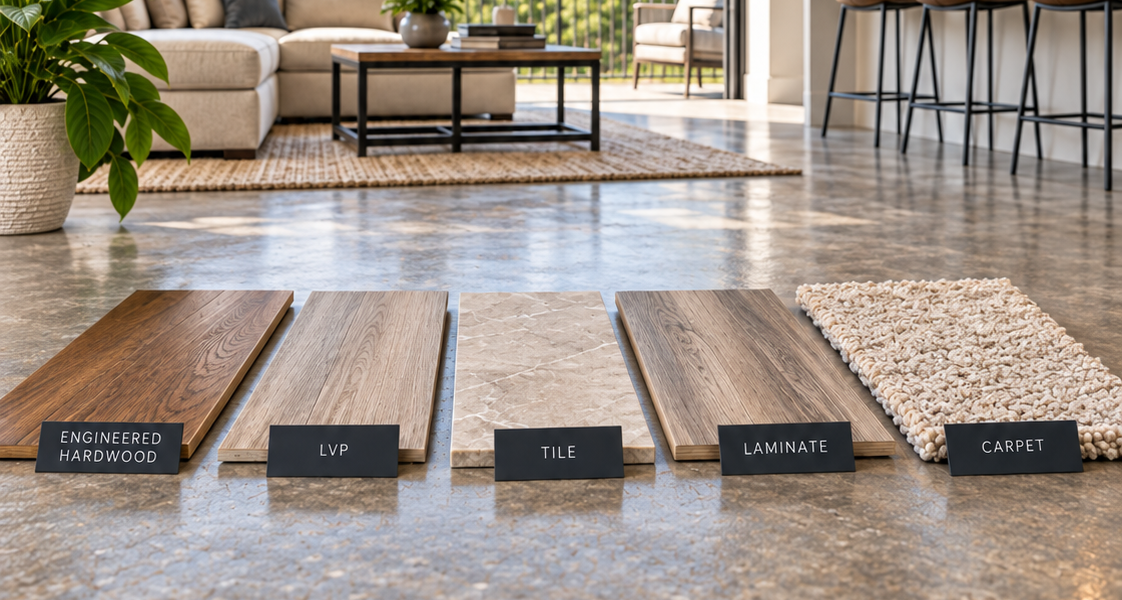
The important thing to know is that there is no single flooring material that is automatically “best” just because your Austin home is built on a concrete slab foundation.
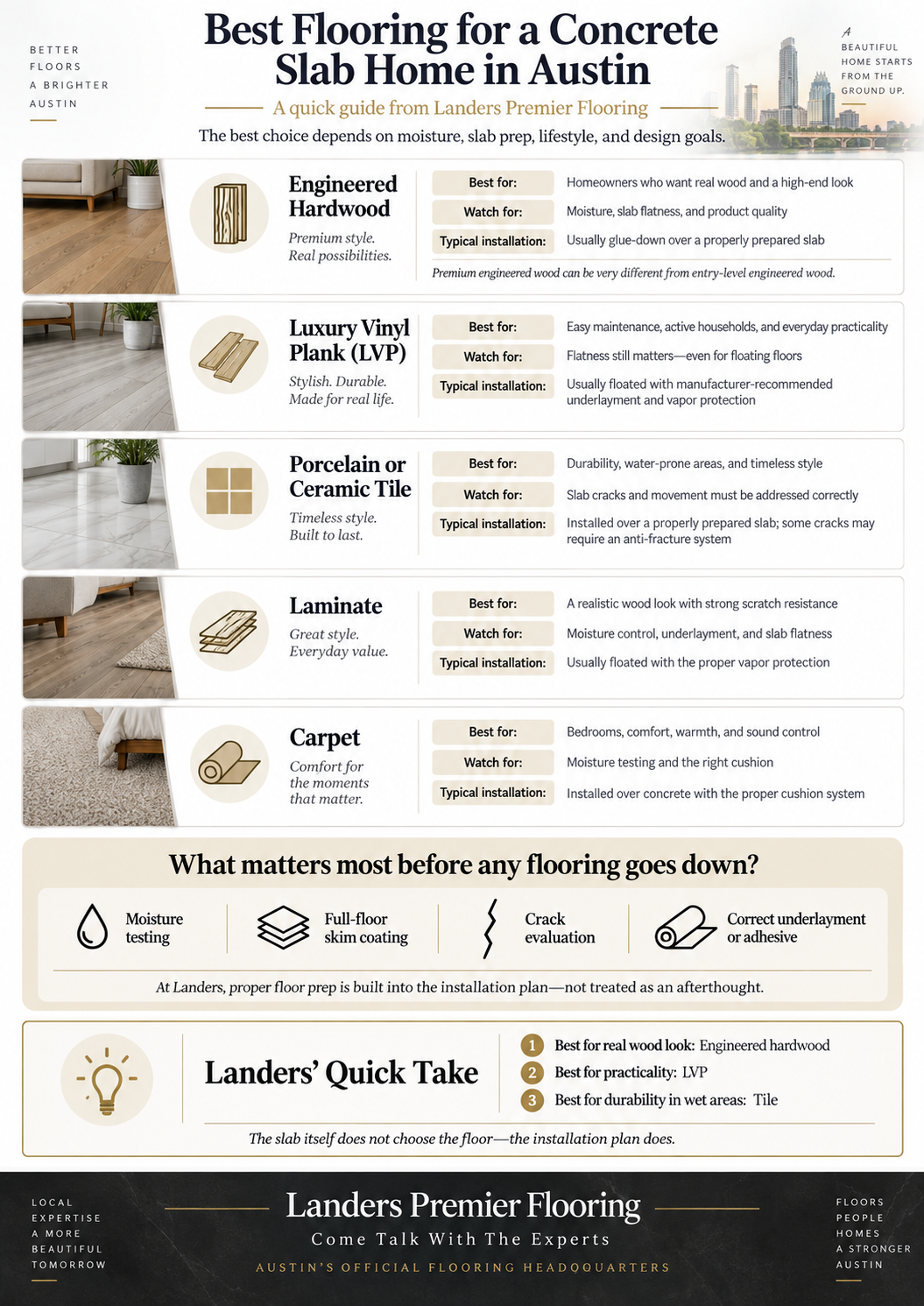
The condition of the slab—and how it is prepared—matters just as much as the flooring you choose.
At Landers Premier Flooring, we work in Austin homes with concrete slab foundations every day. Before installing new flooring, we evaluate moisture, flatness, cracks, transitions and the requirements of the specific product being installed.
A beautiful floor starts with choosing the right material, but how that floor performs over time has a lot to do with what happens underneath it.
Why Does a Concrete Slab Matter When Choosing Flooring?
A concrete slab may look solid and simple, but there is quite a bit going on underneath your finished flooring.
Concrete can transmit moisture. It can have high and low areas that are not obvious until the existing flooring is removed. It can also develop cracks over time. In Austin and Central Texas, expansive soils can contribute to foundation movement as moisture conditions change.
That does not mean homeowners with slab foundations have fewer flooring choices. It simply means the installation needs to be planned around the slab.
Before we install flooring over concrete, we moisture test the slab and document those readings. We also check the surface for flatness and inspect visible cracks and other conditions once the existing flooring has been removed.
That is why buying flooring involves more than choosing the sample you like best.
Engineered Hardwood: Our Choice When You Want Real Wood
If your goal is to have a genuine wood floor, engineered hardwood is often an excellent choice for an Austin slab home.
Engineered hardwood is made with a real hardwood wear layer over a layered core. That construction gives it greater dimensional stability than traditional solid hardwood and makes it better suited for many concrete-slab installations.
In Austin homes, we frequently glue engineered hardwood directly to a properly prepared slab using a high-quality urethane adhesive that is appropriate for the product and site conditions.
This gives homeowners the look and feel of real wood without the need to build a traditional wood subfloor over the concrete.
That is especially helpful in a remodel, where finished floor height can create problems if it is not considered from the beginning.
A glue-down engineered floor usually adds far less height than a solid hardwood installation that requires a wood subfloor or sleeper system. That can make transitions into existing tile, stone, carpet or other flooring much easier to manage.
Floor height can also affect doors, cabinetry, appliances, stair transitions and other details in the home. In a remodel, even a small difference in height can matter.
Engineered hardwood gives us much more flexibility when we are introducing real wood into an existing Austin home.
One distinction gets overlooked frequently: not all engineered hardwood is created equal.
An entry-level 3/8-inch-thick, 5-inch-wide engineered plank with a thin rotary-peeled wood surface is very different from a premium 5/8-inch-thick, 8-inch-wide plank with a substantial dry-sawn hardwood wear layer.
Better engineered floors can offer a more natural appearance, more substantial construction and a thicker real-wood surface. Some premium products also have wear layers thick enough to allow future refinishing, depending on the product and manufacturer specifications.
So when someone says, “Engineered hardwood is good for concrete,” our next question is usually: Which engineered hardwood?
For a higher-end home in Westlake, Northwest Hills, River Place or another Austin neighborhood where the homeowner wants the appearance and feel of genuine hardwood, a quality engineered floor installed properly over a prepared slab can be an excellent choice.
Luxury Vinyl Plank: Practical, Durable and Slab-Friendly
Luxury vinyl plank, or LVP, is another popular option for Austin slab homes.
It is easy to maintain, available in a wide range of wood looks and works well for active
households. It also handles everyday spills and moisture from above very well.
At Landers, we primarily install LVP as a floating floor rather than gluing it directly to the slab.
There are situations where glue-down LVP makes sense, but in residential slab homes we generally prefer a quality floating product when it is appropriate for the space.
A floating installation allows the floor to move as the manufacturer intended without bonding every plank directly to the concrete.
But floating does not mean the slab can be ignored.
We still moisture test the concrete, prepare the slab and use the vapor protection and manufacturer-recommended underlayment required for that particular product. Depending on the construction of the floor, that system may also provide additional cushioning when the product does not already have an attached backing.
One of the biggest misconceptions about floating LVP is that the slab does not need to be as flat because the floor is not glued down.
In reality, low and high areas can allow the planks to move underfoot and put unnecessary stress on the locking system. Proper floor preparation matters just as much with a floating floor.
Tile: Extremely Durable, But Concrete Cracks Matter
Porcelain and ceramic tile are natural choices over concrete and remain some of the most durable flooring materials available.
Tile works especially well in kitchens, bathrooms, utility rooms, entryways and pool homes because it handles water exposure well and stays relatively cool underfoot.
One misconception we hear often is:
“It's concrete underneath, so tile can't move.”
Unfortunately, that is not always the case.
Concrete can crack and move, and that movement can sometimes transfer into the tile installation above it.
Before installing tile, we inspect visible cracks and evaluate the condition of the slab. Certain nonstructural cracks may call for a crack-isolation or anti-fracture system depending on the type and width of the crack, the amount of movement involved and the installation products being used.
We can address the slab conditions that are visible at the time of installation, but no flooring contractor can predict where a slab may crack in the future.
Austin foundations can continue to move as soils expand and contract or as a home settles over time. If a new crack develops later, that movement can sometimes transfer through the tile above it.
Crack-isolation and anti-fracture products are useful for certain existing nonstructural cracks, but they cannot guarantee that tile will never crack if the slab moves in the future.
Control joints, expansion joints and cracks involving vertical or structural movement need to be evaluated differently and cannot simply be treated like ordinary surface cracks.
This is where installation experience matters. The installer needs to understand which cracks can be addressed with an isolation system and which conditions may point to a larger issue.
Laminate: Another Strong Wood-Look Option
Today's better laminate flooring deserves serious consideration in slab homes.
Modern laminate is very different from the inexpensive products many homeowners remember from years ago. Premium laminate can offer very realistic wood visuals, excellent scratch resistance and improved protection against everyday spills.
Like LVP, laminate is generally installed as a floating floor, so many of the same slab requirements apply.
The concrete still needs to be evaluated for moisture and flatness. The proper vapor protection needs to be used, and the installation must follow the manufacturer's requirements for underlayment, expansion spacing and transitions.
When homeowners compare LVP and laminate, we do not automatically assume vinyl is the better answer.
A quality laminate can be a very good choice depending on the room, the household and what matters most to the homeowner.
What About Carpet Over a Concrete Slab?
Carpet works very well over concrete and is still one of our favorite options for bedrooms, media rooms and spaces where comfort and sound control are important.
The carpet cushion matters too. The right cushion affects how the carpet feels, performs and wears over time, and there are products with additional moisture-protection features when they are appropriate.
For homeowners who want a softer bedroom floor in Circle C, Steiner Ranch or Four Points, there is no reason to eliminate carpet simply because the home has a concrete foundation.
The flooring should fit the room and the way you live.
What About Solid Hardwood?
Solid hardwood is beautiful, but it is generally not our first recommendation for installation directly over an Austin concrete slab.
Traditional solid hardwood is designed primarily for nail-down installation over a suitable wood subfloor. Installing it over concrete usually requires additional construction to create that substrate, which adds both height and complexity.
That extra height can be especially difficult in a remodel, where the new floor has to transition into existing tile, stone or other surfaces and still work with doors, cabinets, appliances and stairs.
Engineered hardwood gives Austin homeowners the opportunity to have a genuine hardwood floor using an installation method that is usually much better suited to a concrete slab.
That is one of the main reasons engineered hardwood has become such an important flooring category in Central Texas.
Before Any of These Floors Go Down, the Slab Has to Be Ready
You can buy an excellent engineered hardwood, premium LVP, high-end laminate or beautiful porcelain tile and still have problems if the slab underneath it is not prepared correctly.
As we discussed in our article “What Makes a Quality Flooring Installation for Austin Homes? Why Floor Prep Matters More Than You Think,” flat is not the same thing as level.
A floor does not necessarily need to be perfectly level, but it does need to meet the flatness requirements of the flooring manufacturer and installation system.
At Landers Premier Flooring, we do not believe in throwing a little patch into a few obvious low spots and calling the slab prepared.
For installations that require full-floor preparation, we skim coat the entire installation area rather than relying on spot floating.
We do that because we want a consistent substrate underneath the finished floor.
It takes more material and more labor than correcting only a few visible areas, which is one reason installation quotes from two flooring companies can look quite different even when the flooring itself is similar.
We build anticipated floor preparation into our proposals up front rather than treating normal preparation as a surprise add-on after the project begins.
There can still be concealed conditions that no flooring company can see until the existing flooring is removed. But our goal is to account for proper installation from the beginning instead of quoting the lowest possible installation price and dealing with floor prep later.
Required floor preparation must also be performed for the installation to qualify for Landers Premier Flooring's retail Limited Lifetime Installation Labor Warranty.
For us, floor preparation is not an optional upgrade. It is part of installing the floor correctly.
So, What Is the Best Flooring for Your Austin Slab Home?
There is no single answer for every house.
If your priority is having a genuine wood floor rather than a wood-look product, we would usually start with quality engineered hardwood.
If you have an active household and want easy maintenance and everyday practicality, LVP may be a better fit.
If durability and water resistance are your top priorities, porcelain or ceramic tile may make the most sense.
If you like the look of wood and want strong scratch resistance, today's better laminates are worth considering.
And if you want softness, warmth and quiet in a bedroom or media room, carpet may still be exactly the right choice.
The slab should not automatically determine which flooring you choose, but it absolutely needs to be part of the installation plan.
The Landers Difference Is Under the Floor, Too
“Come Talk With The Experts” at Landers Premier Flooring — Austin's Official Flooring Headquarters.
Landers Premier Flooring
2601 McHale Court #140
Austin, TX 78758
512-873-9470